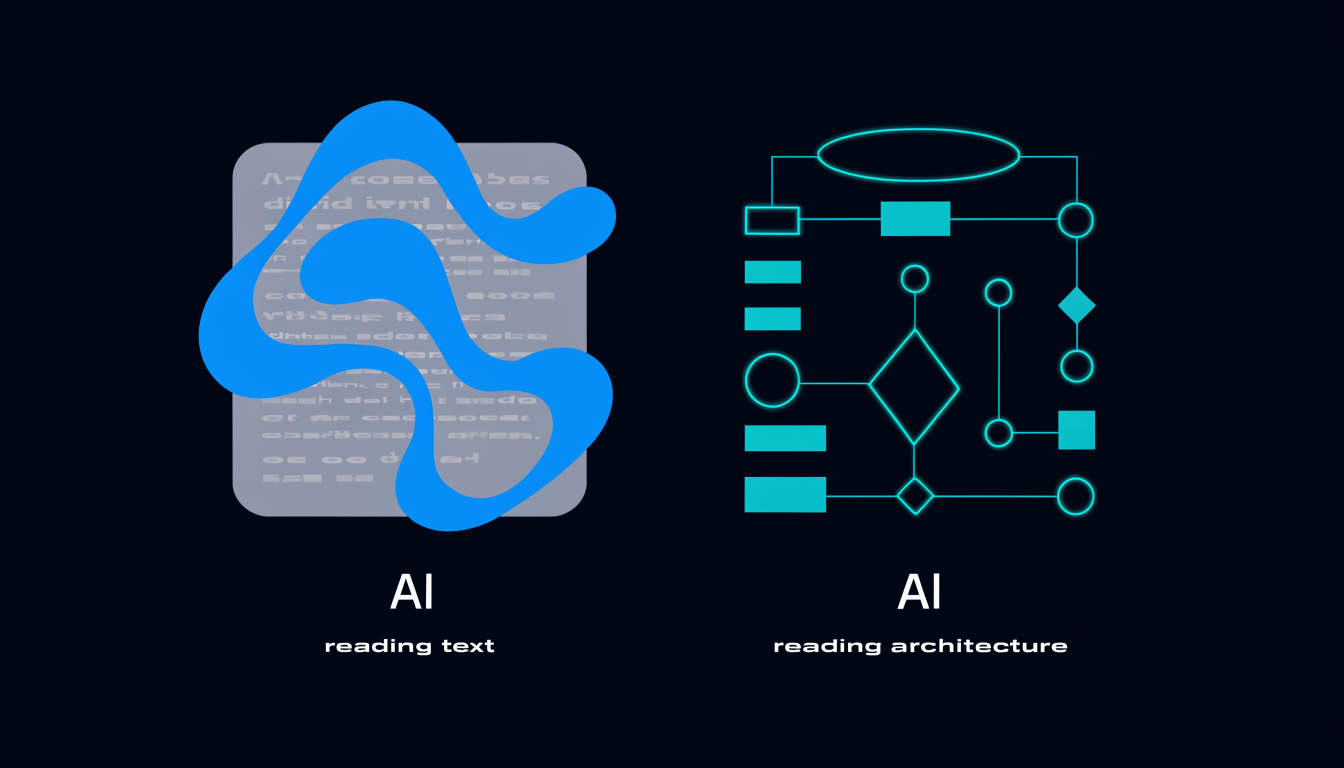
Ask an AI to "build a system with a REST API, a queue for background jobs, and a Postgres database" and it will build something reasonable. But "reasonable" is doing a lot of work in that sentence. The queue, what triggers it? The database, what schema? The API, what versioning convention, what auth model, what error contract?
Prose prompts are inherently ambiguous about structure. A drawing is not.
What a blueprint makes explicit that prose cannot
When you draw a system on a Spiderbrain blueprint, you make decisions visible that a text prompt keeps implicit:
Directionality: an arrow from the API to the queue makes explicit that the API produces jobs; an arrow from the queue to the worker makes explicit that the worker consumes them. Prose says "there is a queue", the canvas shows who produces and who consumes.
Boundary: shapes with explicit boundaries (a service boundary, a network boundary, a team boundary) communicate containment. "The auth service is inside the API gateway" is a structural decision that prose often elides. On the canvas it is a shape inside another shape, unambiguous.
Type tagging: each component is tagged with its type, database, queue, cache, external API, service. The AI knows not to treat a cache the same way it treats a database; not to treat an external API the same way it treats an internal one. Type tagging carries those constraints without requiring you to spell them out each time.
Missing components: what is not on the canvas is as informative as what is. If there is no cache between the API and the database, the AI should not add one speculatively. The canvas is the architectural authority.
The precision gap in prose-first building
In a prose-first workflow, ambiguities accumulate. Each session starts from a natural-language description, and each time the AI reconstructs its understanding of the system from scratch. Small misinterpretations in session 1 propagate into session 3.
Teams using prose-first AI builds routinely discover that the AI made an architectural choice in session 2 that contradicts a decision made in session 1, because there was no persistent, authoritative representation of the architecture for it to check against.
A blueprint is that persistent representation. It does not change between sessions unless you change it. It gives the AI a stable reference that does not degrade through natural-language re-description.
The "Copy as text" bridge
Not every AI client speaks MCP. For a chat-only session, Spiderbrain’s "Copy as text" button exports the entire canvas as Markdown, a structured text representation that any AI can consume. The structure is preserved: nodes listed with their types, edges listed with their directionality, annotations included.
This makes blueprint-first a workflow that works even outside the Spiderbrain ecosystem. Draw the system, copy as text, paste into any AI session. The building context is more precise than a prose prompt even without a native MCP connection.
What changes in the build output
Teams that switch from prose-first to blueprint-first building report three consistent improvements:
-
Fewer implementation surprises: the AI does not speculate about components that are not in the blueprint. The scope is bounded by the drawing.
-
Faster session starts: each new session begins from the blueprint, not from a re-narration. The "here’s what we’re building" preamble shrinks dramatically.
-
More useful reviews: code reviews can now reference the blueprint. "This change adds a direct database call from the worker, the blueprint shows that should go through the API" is a structurally-grounded review comment, not a preference.
Drawing is thinking
The most underrated benefit of blueprint-first is that drawing forces decisions. You cannot draw an ambiguous system. When you put shapes on a canvas and draw arrows between them, every relationship you want to leave vague must eventually be resolved into a direction, a type, and a boundary.
That forced resolution happens before the AI writes a line of code, when it is cheapest to change.