Imagine AI without the risk, inconsistency, or hallucinations
Spiderbrain delivers deterministic memory, blast-radius analysis, and zero-exposure code mapping for enterprise AI.
Why a business needs a deterministic context layer
Each layer depends on the one beneath it holding true. Together they give reproducible answers, shared understanding, and risk you can see before you ship. If you are weighing it against a data catalog, here is how a context layer differs from a semantic layer.
01Execution layer
Agents and tools act on real structure instead of guessing, all against the same ground truth.
02Context layer
A live map of what depends on what, calculated from source, so impact is visible before it ships.
03Semantic layer
A shared dictionary that turns fragmented data into business meaning an agent can act on.
04Memory layer
Persistent, versioned and shared, so the understanding survives the session and the team.
05Compliance layer
Policies and regulations live in the brain as typed, versioned artifacts, not prompt suggestions.
06Governance layer
Nothing governs an agent until a person ratifies it, and every rule carries who approved it.
A brain for your business. Clarity for every decision.
Before Spiderbrain
no shared brain
Every team answers from its own copy of the truth. Work gets redone, decisions wait on somebody to reconcile the numbers, and the cost of running it all keeps climbing.
After Spiderbrain
one shared brain
One governed answer every team can act on. The reconciling disappears, decisions land sooner, and the same operation costs less to run.
Every business will adopt AI. The businesses that win will build a robust Brain first.
Local machine
Private data and code
- 01
Spiderbrain reads your files and builds a deterministic, governed brain: your organization’s understanding, in one place.
- 02
Unlike AI models, the brain is persistent, versioned, auditable, and reusable.
- 03
Connect any AI through MCP, or embed it in your own applications with the Spiderbrain API.
One brain, plugged into everything that needs to know
Your software can ask what depends on what, what a change breaks, and why a decision was made.
Inside your own apps
Ask how far a breakage reaches before a customer finds out.
- Impact analysis before deployments
- Change-risk scoring
- Incident root-cause exploration
- Migration planning
Docs and knowledge bases
Pages your latest release made stale get flagged, not left to rot.
- Detecting stale documentation
- Broken citations and references
- Contradictory or duplicate knowledge
- Decisions with no recorded rationale
Auditor portals
Auditors open the current picture, not last quarter.
- Exactly what changed since the last audit
- Reproduce the understanding as of the audit date
- Which evidence supports this control
- Requirements with no evidence attached
Security reviews
See where risk sits, and how far it spreads if that piece moves.
- What depends on this vulnerable package
- How far the exposure propagates
- Which customers are exposed
- Known relationship versus model inference
Sales enablement
Reps see what an offer does to a bundle before they promise it.
- Which products are compatible
- Which discounts conflict
- Which contract terms supersede standard pricing
- Which claims have no current evidence
Analytics
Query the blind spots nobody thought to ask about.
- Which reports depend on this upstream system
- Where a metric is defined more than once
- Which dashboards a schema change breaks
- Numbers with no traceable source
How do you plan to use the Spiderbrain?Read the API docs
Do not take determinism on faith. Audit it
Determinism is only worth anything if you can check it. Methodology, results and gaps are all published.
Open reproducibility benchmark
When we found a defect in our own engine, we published the defect, the fix and the verified re-run the same day.
contextbenchmark.com (opens in a new tab)Signed transparency log
Every brain in the public registry lands in a signed, append-only log: what was published, when, and with which fingerprint.
View the logRuns where you need it
Parsing runs inside your environment. Scoring and hosting run on our EU infrastructure today. Only the derived understanding travels, never your file contents. Ask us about regional or self-hosted deployment.
Read the data governance policydet-score
The brain tells you what it does not know. Coverage is disclosed per repository, never silently overstated.
How det-score works
Measured on 14 real datasets, from code to clinical trials, each figure tagged with the engine version it was measured on.
Three ways to give an AI context. Only one of them can prove it
An agent on its own guesses from similarity. A memory tool remembers what a model extracted. Spiderbrain derives the structure from your source and can show its work.
| What you need | AI agent alone | AI + memory tool | AI + Spiderbrain |
|---|---|---|---|
| Trust | |||
| Same input, same context, every time | no | no | yes |
| Built from your source, not inferred by a model | no | no | yes |
| Answers you can re-run and verify | no | no | yes |
| Tells you what it does not know | no | no | yes |
| Understanding | |||
| Knows what depends on what | partial | no | yes |
| Knows what breaks before you ship it | no | no | yes |
| Useful even with no AI in the loop | no | no | yes |
| Governance and time | |||
| Survives the session | no | yes | yes |
| Shared by the team, not rebuilt per seat | no | yes | yes |
| Versioned, so you can diff what changed | no | partial | yes |
| Your file contents never have to leave your machine | partial | no | yes |
Determinism is a property of the map Spiderbrain builds, not of the sentences a model writes from it. Other categories reflect public product information as of July 2026, and describe categories, not named products.
Understanding Starts With Measurement
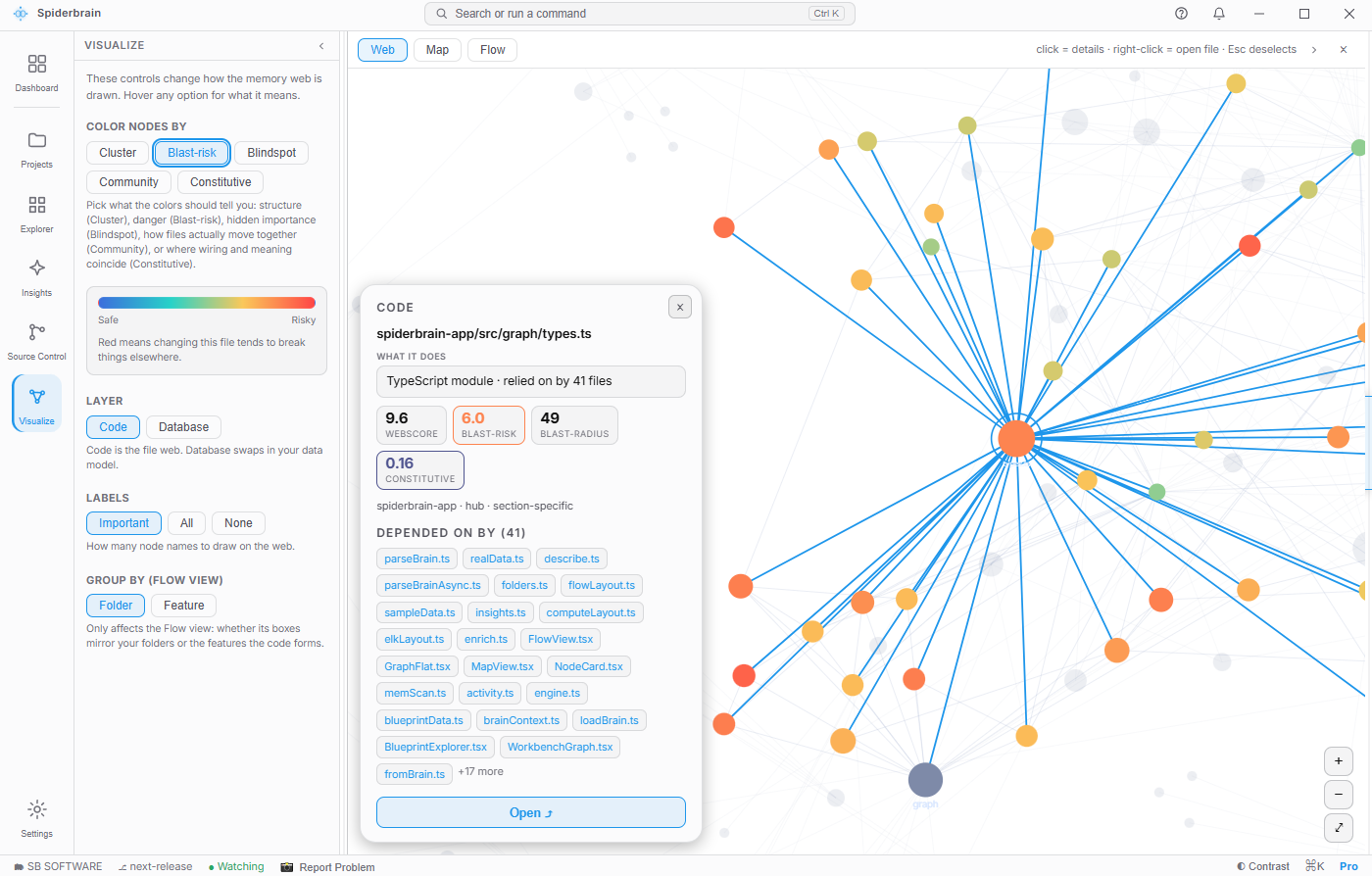
Every file gets scored, so the load-bearing few surface on their own instead of drowning in a context window. Same input, byte-identical output.
Your rules, ratified. Your agents, governed
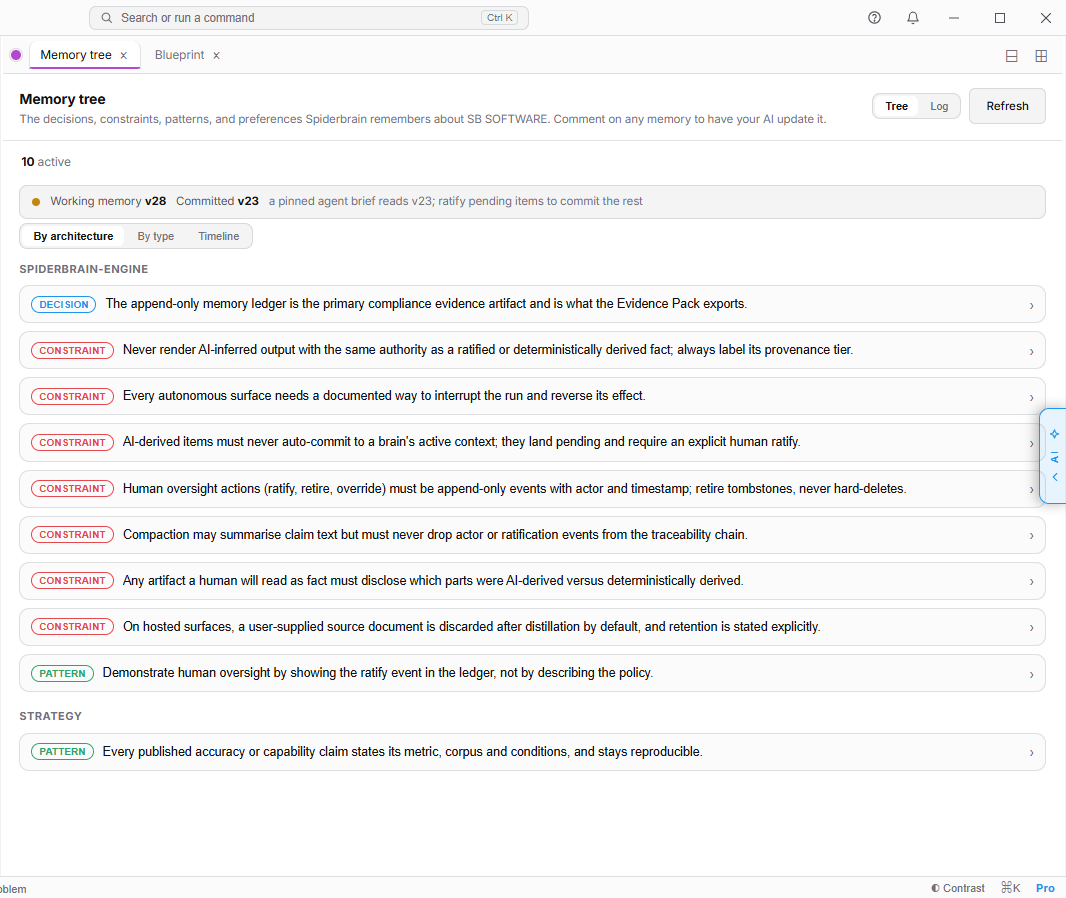
Bring your policies and architecture documents. Each rule becomes a typed directive that waits in quarantine until a person ratifies it. Only then does it govern your agents, and it records who approved it and when. Retire a rule and the audit trail stays.
High-risk AI output requires effective human oversight. Agent-proposed changes to deployment-gating code must be reviewed by a person before merge.
Runs where your data has to stay.
Because only the derived understanding ever travels, never your file contents, where the brain runs is a choice rather than a risk.
In your own data centre.
Installed inside your own perimeter, on infrastructure you control, and provisioned for your organisation alone.
In your own VPC.
Runs in a cloud account that belongs to you, on a dedicated instance sized to your scale, under your own domain.
Where your source already lives.
Parsing runs inside your environment. Your source code, file contents, commit messages and author emails never leave it. Only a source-free graph travels, for scoring.
How it is deployed per client · What travels and what does not